


As an Amazon Associate I earn from qualifying purchases.



An oil stop leak is an additive you pour in with the engine oil to slow or stop a leak without taking the engine apart. On the right leak it is a genuinely cheap fix for a repair that might otherwise cost hundreds of dollars in labor. On the wrong leak it does nothing at all, and the biggest mistake buyers make is not knowing which kind they have.
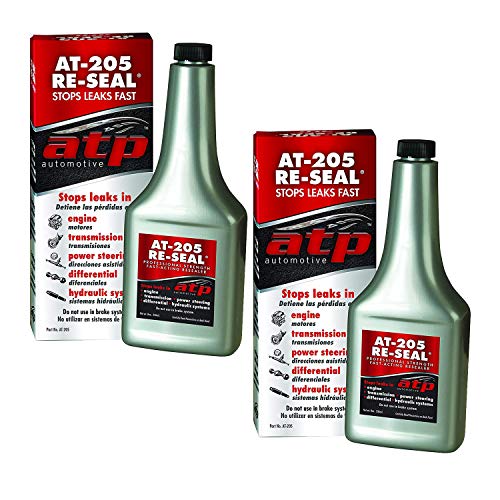
For most leaks, ATP AT-205 Re-Seal is the best oil stop leak: a small dose, no petroleum distillates, and a formula ATP says will not over-swell seals, so it also works in transmissions, power steering and differentials. Bar’s Leaks Rear Main Seal Repair is the specialist for the leak most worth avoiding a repair on, and Bar’s Leaks OS-1 is the pick for an engine that burns oil as well as leaking it. The seventh product is not a sealer at all, but a dye that tells you where the leak actually is before you spend money on anything.
What an Oil Stop Leak Can and Cannot Fix
Engine oil stop leaks work on rubber seals. Lucas, for example, describes its top-off formula as using seal swell agents to condition hard and shrunken seals and gaskets. As rubber ages and heat-cycles, it hardens and shrinks away from the surface it seals against; a conditioner softens and slightly swells it so it seals again. That is why the classic success story is an older, high-mileage engine with a slow seep from a crankshaft seal, a camshaft seal or a rubber valve cover gasket.
It follows that a stop leak cannot fix anything that is not an aged rubber seal. That includes a loose drain plug or oil filter, a torn or pinched gasket, a cracked oil pan or timing cover, a leaking oil cooler line, or oil being pushed out because a blocked crankcase ventilation system has pressurised the engine. A fast leak that leaves a puddle overnight is almost always one of those, and needs a proper repair.
Car makers are wary of additives in general. American Honda’s position statement on additives and flushes tells owners that their vehicle does not require oil additives and that “they may adversely affect the engine performance and durability”. That is a statement about routine use in a healthy engine; a stop leak is a targeted repair for an older one. But it is a good reason to use these products only when there is a real leak, not as a preventive treatment, and to think twice on a car still under warranty.
Here is how they compare at a glance:
| Product | Type | Best For |
|---|---|---|
| ATP AT-205 Re-Seal | Non-petroleum seal conditioner | Best overall |
| Bar’s Leaks Rear Main Seal Repair | Seal conditioner | Rear main and other hard-to-reach seals |
| BlueDevil Oil Stop Leak | Non-petroleum seal conditioner | Engines and drivetrain seals |
| Lucas Oil Engine Oil Stop Leak | Thick oil treatment and stop leak | High-mileage engines with noise and consumption |
| Bar’s Leaks OS-1 Oil Seal | Stop leak and oil-burning repair | Engines that burn and leak oil |
| Permatex Engine Oil Stop-Leak | Stop leak | Budget pick, including hybrids and diesels |
| A/C Pro Oil and Fuel System UV Dye | UV leak detection dye | Finding the leak first |
1. ATP AT-205 Re-Seal
AT-205 has a reputation among mechanics that few additives earn, and its formula explains why. ATP says it contains no petroleum distillates and will not over-swell or break down seals, which is the main risk with cheaper seal conditioners: too much swell and a seal can distort, too much solvent and it softens and fails.
It is also unusually versatile. ATP says it rejuvenates rubber seals and gaskets in engines, transmissions, power steering systems, differentials and hydraulic systems, and that it is compatible with conventional and synthetic oil, automatic transmission fluid, gear oil, power steering fluid and hydraulic oil. One 8-ounce bottle is a small dose relative to the oil in a typical engine, so it barely changes the oil’s viscosity.
Like every product here, it needs time and driving to work, and it will only help where the leak is an aged rubber seal.
Best for: Slow seeps from aged rubber seals in the engine or elsewhere in the drivetrain.
Pros:
- No petroleum distillates; ATP says it will not over-swell seals
- Works in engines, transmissions, power steering and differentials
- Small dose with little effect on oil viscosity
Cons:
- Costs more per bottle than basic stop leaks
- Will not fix gasket or hardware leaks
2. Bar’s Leaks Rear Main Seal Repair
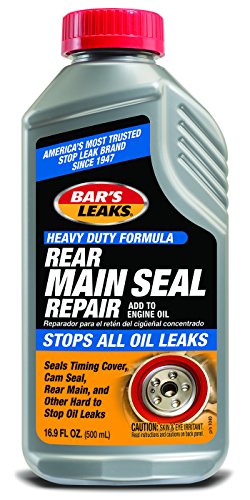
The rear main seal sits between the engine and transmission, and replacing it usually means removing the transmission, which is why a rear main seal leak is the one most worth trying a stop leak on first. Bar’s Leaks designed this formula for exactly that job, and says it also seals timing cover, cam seal and other hard-to-stop oil leaks.
Use is simple: add the whole bottle to the crankcase at or between oil changes, without overfilling. Bar’s Leaks says most leaks stop within 100 miles or two days of driving, which gives you a clear point at which to judge whether it has worked.
If the drip is still there after that, the seal is probably physically damaged rather than shrunken. Our guide to rear main seal leak symptoms covers how to confirm that the leak really is the rear main and what the repair involves.
Best for: Rear main seal and other crankshaft or camshaft seal leaks, especially where the repair would mean removing the transmission.
Pros:
- Designed specifically for rear main seal leaks
- Clear guidance: most leaks stop within 100 miles or 2 days
- Low price for a potentially large labor saving
Cons:
- Full 16.9-ounce bottle takes up room in the crankcase
- Cannot repair a torn or displaced seal
3. BlueDevil Oil Stop Leak

BlueDevil is best known for its head gasket sealer, and its oil stop leak follows a similar idea to AT-205: a non-petroleum formula that the company says will not temporarily swell seals or clog the system. BlueDevil describes it as a permanent seal that keeps the leak sealed after miles of driving.
It is compatible with gasoline and diesel engines, and BlueDevil lists a long range of other uses: pinion seals, gear cases, axle seals, differentials, gearboxes and refillable shock absorbers. That makes one bottle useful beyond the engine.
The listing linked here is a two-pack, which suits a high-mileage vehicle with more than one seeping seal, or anyone keeping a spare for a second vehicle.
Best for: Engines and drivetrain components where you want a non-petroleum formula.
Pros:
- Non-petroleum, non-clogging formula
- Gasoline and diesel compatible
- Also suits axles, differentials and gearboxes
Cons:
- Sold here as a two-pack
- Takes driving time to work, like all seal conditioners
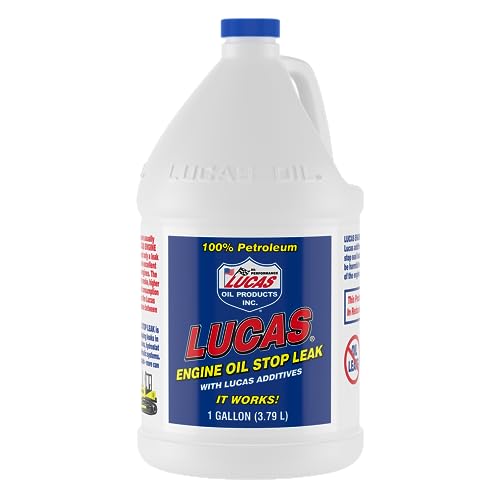
4. Lucas Oil Engine Oil Stop Leak
Lucas Engine Oil Stop Leak is a different style of product from the first three. It is a full quart of thick oil treatment as well as a seal conditioner, so it changes the character of the oil as well as treating the seals. Lucas says it renews worn seals with no risk of damage or corrosion, contains no harmful solvents, and works with conventional, synthetic blend and full synthetic oil.
Lucas also claims it reduces engine noise and oil consumption and raises oil pressure. That is the effect of the thicker blend, and it is why this suits a tired, high-mileage engine that ticks, smokes a little and leaks a little, rather than a newer engine with one bad seal.
Because it is a full quart, replace a quart of oil with it rather than adding it on top, so the crankcase is not overfilled. And because it thickens the oil, it is not the right choice for a modern engine that specifies a thin oil such as 0W-20; our comparison of 0W-20 and 5W-30 explains why the specified viscosity matters.
Best for: Older, high-mileage engines with seeping seals, some oil consumption and a bit of valve-train noise.
Pros:
- Combines a seal conditioner with a thick oil treatment
- Compatible with conventional and synthetic oils
- No harmful solvents, according to Lucas
Cons:
- Thickens the oil, so not for engines specified for thin oil
- Displaces a full quart of engine oil
5. Bar’s Leaks OS-1 Oil Seal
OS-1 targets two problems at once: oil leaking out of the engine and oil being burned inside it. Bar’s Leaks says it repairs leaking main seals and gaskets, renews worn valve seals and guides, and stops oil burning and blue exhaust smoke, in gasoline and diesel engines including turbocharged and hybrid engines.
Bar’s Leaks also sets a useful limit on the listing: a vehicle is a good candidate if it does not consume more than one quart of oil per day. An engine burning more than that has a problem no additive will touch.
Blue smoke on start-up is the classic sign of worn valve stem seals, which are exactly the kind of aged rubber seal these products can help. Our guide to blue smoke from the exhaust explains how to tell valve seals from worn piston rings.
Best for: Engines that both leak oil and burn it, with smoke on start-up.
Pros:
- Treats leaks and oil burning together
- Suits turbocharged, hybrid and diesel engines
- Clear candidate limit: no more than a quart a day
Cons:
- Will not help worn piston rings or heavy consumption
- Larger dose than AT-205 or BlueDevil
6. Permatex Engine Oil Stop-Leak

Permatex is best known for gasket makers and thread lockers, and its engine oil stop leak is the budget pick here. Permatex says it suits all gasoline and diesel four-stroke engines, including hybrids, and is meant for small to moderate oil leaks.
Permatex describes it as revitalising rubber and neoprene seals and O-rings, reducing blow-by and oil burning, and providing a long-lasting seal without dismantling the engine. A 12-ounce bottle is a moderate dose.
At its price, it is a reasonable first try on an older car with a small seep, as long as the leak really is a seal.
Best for: Small to moderate seal leaks on a budget, including hybrid and diesel engines.
Pros:
- Low price
- Suits gasoline, hybrid and diesel four-stroke engines
- Conditions rubber and neoprene seals and O-rings
Cons:
- Less of a track record than AT-205 or Bar’s Leaks
- Not for large leaks, by Permatex’s own description
7. A/C Pro Oil and Fuel System UV Dye

This is not a stop leak. It is here because the most useful thing to do before buying any of the products above is to find out exactly where the oil is coming from. Oil runs downhill and gets blown backwards by airflow under the car, so the wet patch is often a long way below and behind the real leak.
A/C Pro’s dye is a single application that mixes into the engine oil, and it works in transmissions, power steering systems and fuel systems too. A/C Pro says it is compatible with all weights of petroleum-based lubricant. After a short drive, a UV lamp makes the leak point glow, which tells you whether you are looking at a seal (worth trying a stop leak), a gasket or hardware (needs a repair), or something else entirely.
You will need a UV flashlight to see it, which this listing does not include. Cheap ones work fine.
Best for: Anyone who is not certain where an oil leak is coming from.
Pros:
- Pinpoints the leak before you spend money
- Works in engine oil, transmission, power steering and fuel
- Inexpensive single application
Cons:
- Not a sealer; it only finds the leak
- Needs a separate UV light
Things To Keep In Mind Before You Buy
Find the Leak Before You Treat It
Clean the area, run the engine, and look from above and below, or use a UV dye like #7. The most common leaks on older engines are the valve cover gasket, the oil pan gasket, the drain plug, the oil filter and the rear main seal. Of those, only the rubber seals and gaskets are candidates for a stop leak. A drain plug or filter just needs tightening or a new washer, and our guide to oil pan gasket leaks covers the most common gasket repair.
Check for Oil on the Exhaust
A slow leak dripping on the driveway is mostly a mess. A leak dripping onto a hot exhaust manifold is a fire risk, and it is usually the first sign: a burning-oil smell after driving, or smoke from under the hood. If you smell it, find the source before relying on an additive; our guide to a car that smells like burning oil explains where to look.
Give It Time, and Measure the Result
Seal conditioners work over driving time, not in minutes. Bar’s Leaks says most leaks stop within 100 miles or two days. Before you add anything, put a piece of cardboard under the engine overnight; repeat after a few hundred miles. A smaller spot is progress. The same spot means the leak is not a seal problem.
Don’t Stack Products or Overfill
Use one stop leak at a time. Mixing two seal conditioners makes it impossible to tell which one worked, and doubles the dose of swell agent. Check the dipstick after adding any product, because full-bottle doses like Lucas and Bar’s Leaks take up crankcase volume. Drain a little oil first if needed, rather than running the engine overfilled.
Why a Slow Leak Is Still Worth Fixing
Beyond the risk of running low on oil, leaked oil ends up in storm drains and waterways. The EPA notes that used oil from one oil change can contaminate one million gallons of fresh water. Our guide to what happens if you ignore an oil leak covers the mechanical risks.
Winners And Losers
ATP AT-205 wins for most leaks: a small dose, no petroleum distillates, and a formula ATP says will not over-swell seals, with uses well beyond the engine. Bar’s Leaks Rear Main Seal Repair is the cheapest first attempt on the most expensive leak to repair, and BlueDevil is a strong non-petroleum alternative.
For tired, high-mileage engines, Lucas Engine Oil Stop Leak adds a thick oil treatment, and Bar’s Leaks OS-1 tackles oil burning and leaks together. Permatex is the budget choice for a small seep.
The loser is any stop leak poured into an engine with a hardware or gasket leak. That is why the A/C Pro UV dye earns its place: finding the leak first is what makes the other six worth buying.
To Sum Up
Find the leak, confirm it is an aged rubber seal, pick one product, and give it a couple of days of driving before judging it. For the right leak, a stop leak can save a repair bill that is mostly labor. For the wrong one, the fix is a gasket, a seal or a tightened drain plug.
If the engine also needs a general oil treatment rather than a sealer, our roundup of the best engine oil additives covers the wider category, and our guide to the common causes of oil leaking from the bottom of the engine helps narrow down the source.
Frequently Asked Questions
Do oil stop leak additives really work?
On the right leak, yes. They condition and slightly swell rubber seals that have hardened and shrunk with age, so they work best on slow seeps from crankshaft, camshaft and valve cover seals in older engines. They do nothing for a loose drain plug, a torn gasket, a cracked pan or a damaged seal.
How long does an oil stop leak take to work?
Usually a few days of normal driving. Bar’s Leaks says most leaks stop within 100 miles or two days with its Rear Main Seal Repair. Put cardboard under the engine before and after to measure the result, rather than judging by eye.
Can an oil stop leak damage my engine?
A good one used as directed is unlikely to, but the risk is not zero. Products with petroleum distillates can over-soften seals, and thick formulas change oil viscosity. American Honda says vehicles do not require oil additives and that they may adversely affect engine performance and durability, so use a stop leak only when there is a real leak.
Will an oil stop leak fix a rear main seal leak?
Often, if the seal has hardened or shrunk rather than torn or moved out of place. It is worth trying first, because replacing a rear main seal usually means removing the transmission. If the leak is unchanged after a few hundred miles, the seal needs replacing.
Can I use an oil stop leak with synthetic oil?
Yes, most are compatible. ATP says AT-205 works with conventional and synthetic oils, and Lucas lists its stop leak as compatible with petroleum, semi-synthetic and full synthetic oils. Check the label for any product not listed here.
Is an oil stop leak a permanent fix?
It can last a long time, but it is best treated as a repair that buys time. Seals keep ageing, and some products need to stay in the oil to keep working, so they may need re-dosing after an oil change. If a leak keeps returning or gets worse, the seal or gasket needs replacing.
