


As an Amazon Associate I earn from qualifying purchases.
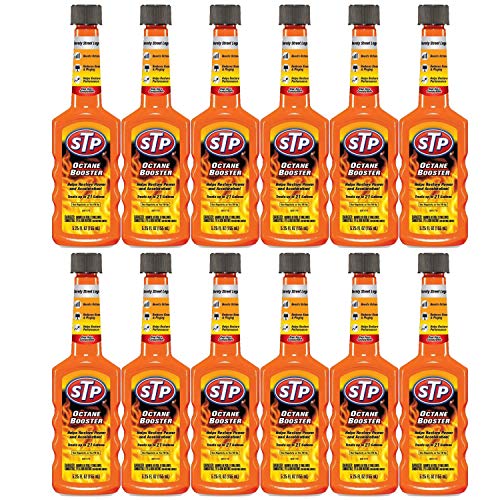

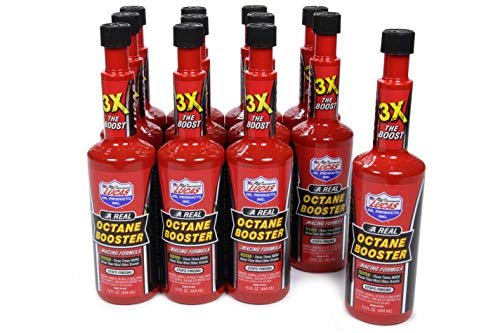



An octane booster is a bottle of additive that raises your gasoline’s resistance to knock, the rattling or pinging sound of fuel igniting before the spark plug fires. It is one of the most oversold products in an auto parts store, and also one of the few that genuinely fixes a real problem in the right car. The trick is knowing which car you have.
For most drivers who need one, the K&N Performance+ Octane Booster is the best pick: it is sold for everyday street use, K&N lists it as safe for catalytic converters and oxygen sensors, and one bottle treats a full tank. Gold Eagle’s Super 104+ gives more boost for a car that is still pinging, and Torco Accelerator is the concentrate to buy for a race or track car. Here are all seven, along with two warnings worth reading before buying any of them.
First, if your owner’s manual says regular fuel, an octane booster almost certainly does nothing for you. FuelEconomy.gov says that under normal driving conditions you may get “little to no benefit” from higher-octane fuel, and AAA’s 2016 lab testing of regular-fuel engines on 87 and 93 octane found “no significant increases in any tested category”, covering horsepower, fuel economy and tailpipe emissions. In AAA’s words, premium gasoline is “higher octane, not higher quality”.
Second, several of the strongest boosters are race products that the manufacturers themselves say are not for road use. That is covered in its own section below the table.
Here is how they compare at a glance:
| Product | Type | Best For |
|---|---|---|
| K&N Performance+ Octane Booster | Street booster and cleaner | Best overall for daily drivers |
| Gold Eagle Super 104+ Octane Boost | Double-strength street booster | More boost for persistent pinging |
| 104+ Octane Boost | Street booster and cleaner | Budget pick |
| VP Racing Octane Booster | High-strength booster | Performance and tuned cars |
| Torco Accelerator | Race fuel concentrate | Track and race cars |
| BOOSTane Professional | Race-only booster | Dedicated race engines |
| Lucas Oil Octane Booster | Booster for non-catalyst engines | Classic cars and small engines |
Read the Label: Points, Numbers and “Not Street Legal”
Two things on octane booster labels catch out more buyers than anything else.
A “point” is a tenth of an octane number
Octane boosters are usually marketed in points, and a point is one tenth of the number on the pump. Royal Purple’s listing for its Max Boost spells it out as “up to 30 points or 3 numbers”, and VP Racing’s listing equates 5 numbers with 50 points. So a bottle that promises “up to 30 points” can move 87-octane gas, at most, to about 90. A product that says “3 points” is talking about 87.3. Claims of “up to” also assume the maximum dose in a set amount of fuel, so a big tank treated with one small bottle gets less.
Some of the strongest boosters are not for road use
BOOSTane’s own listing for its Professional formula says plainly that it “is not street-legal” and is engineered for racing. Royal Purple says the same of Max Boost: “a racing formula and is not street legal”. Lucas lists its 5.25-ounce Octane Booster as designed for engines and vehicles not equipped with emissions aftertreatment systems, which rules out almost every road car built since the mid-1970s, because they all have a catalytic converter. Those products still have a place, and they are on this list for it, but that place is a race car, a pre-catalyst classic or a lawn mower, not a daily commuter.
If the label does not say whether a product is for road use, the safe assumption for a car with a catalytic converter is to buy one that explicitly says it is catalytic converter and oxygen sensor safe. K&N and 104+ both make that claim for their formulas below.
1. K&N Performance+ Octane Booster

K&N is better known for air filters, but its Performance+ booster is a straightforward street formula and the easiest recommendation on this list. One 16-ounce bottle treats up to 18 gallons, which covers a full tank on most cars and SUVs, and it is sold for regular use at fill-up rather than as a one-off race additive.
Two parts of K&N’s description matter for a road car. It lists the formula as safe for catalytic converters and oxygen sensors, which is the first thing to check on any booster going into a car built in the last few decades, and it includes a cleaner for the fuel injectors and internal fuel system parts. K&N says it reduces knocks, pings and hesitation; it does not publish a specific octane gain, which is more honest than an inflated “up to” figure but means you cannot compare it number for number.
It is made in the USA and widely stocked, so it is easy to find a second bottle on a road trip.
Best for: Daily drivers that require premium and occasionally have to fill up with a lower grade, or older cars with light pinging under load.
Pros:
- Listed as safe for catalytic converters and O2 sensors
- Treats up to 18 gallons per bottle
- Includes a fuel-injector cleaner
Cons:
- No published octane gain to compare against rivals
- Modest boost compared with race formulas
2. Gold Eagle Super 104+ Octane Boost

Gold Eagle makes the 104+ line, and Super 104+ is its stronger formula: the company describes it as double the octane boost of its regular 104+. That makes it the step up when a regular-strength booster has not quietened a pinging engine, or when a performance car that requires premium has been filled with midgrade.
Like the standard formula, it is also sold as a fuel-system cleaner. Gold Eagle says it cleans the fuel injectors and the complete fuel system and reduces knocks, pings and hesitation. The “104+” in the name is a brand, not a promise; the listing does not claim it will turn pump gas into 104-octane fuel.
If pinging carries on even with a double-strength booster, the cause is probably not the fuel. See the section on mechanical knock below before buying more bottles.
Best for: Performance cars that require premium, and older engines that still ping on regular-strength boosters.
Pros:
- Twice the boost of the regular 104+ formula, according to Gold Eagle
- Also cleans injectors and the fuel system
- Widely available brand
Cons:
- Costs more per bottle than the standard formula
- Listing does not state a gallon treat rate
3. 104+ Octane Boost
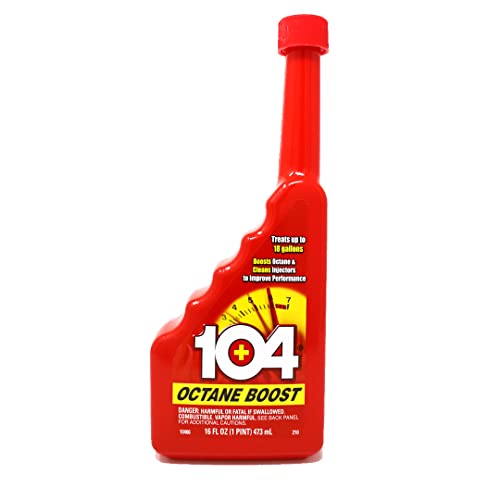
The regular-strength 104+ is the budget pick and one of the most common boosters on auto parts shelves. A 16-ounce bottle treats up to 18 gallons, and the 6-pack version of the listing states it is safe for catalytic converters and oxygen sensors.
The pitch is the same as the others in this price range: it boosts octane, cleans injectors and, according to the manufacturer, improves performance and gas mileage. Treat the mileage claim with caution. Unless your engine was knocking and pulling back its ignition timing to protect itself, there is no lost economy to restore, which is exactly what AAA’s testing on regular-fuel engines found.
For a car that only needs a small push on the odd tank of lower-grade fuel, this is all most people need.
Best for: Cheap insurance for a premium-fuel car stuck with one tank of midgrade or regular.
Pros:
- Low price per bottle
- Treats a full 18-gallon tank
- Sold as catalytic converter and O2 sensor safe
Cons:
- Mild boost compared with Super 104+
- Mileage claims depend on the engine having been knocking
4. VP Racing Octane Booster

VP Racing is a race-fuel company, and its octane booster is the strongest product here that is also marketed to everyday drivers. VP’s listing claims a boost of up to 5 numbers (50 points), which is a lot for an over-the-counter additive, and describes it as suitable for unleaded engines on the track or in daily commuting.
That makes it a sensible choice for tuned cars running more boost or timing than stock, where the margin against knock is thin. VP says each 16-ounce can treats the tank directly. As with every “up to” claim, the maximum figure depends on the dose relative to the amount of fuel.
VP’s listing does not say whether the formula is catalytic converter and oxygen sensor safe. For a stock daily driver, the K&N or 104+ formulas, which do make that claim, are the safer choice.
Best for: Tuned and modified cars that need a bigger knock margin.
Pros:
- Highest claimed boost among street-marketed products here
- From an established race-fuel maker
- Simple one-can dose
Cons:
- No catalytic converter or O2 sensor claim on the listing
- More than a stock daily driver needs
5. Torco Accelerator Unleaded Race Fuel Concentrate

Torco Accelerator is not a booster in the usual sense. It is sold as a race fuel concentrate, mixed with pump gas in whatever proportion the engine needs, and Torco says it can raise octane up to 105. The 32-ounce bottle lets you build a blend for a track day or a dyno session rather than pouring in a fixed dose.
That flexibility is the point. A race or track car that needs more octane than any pump offers can run a measured blend instead of buying drums of race fuel, and the ratio can be tuned to the engine.
The flip side is that a concentrate is the wrong tool for a stock car with a pinging problem. It is expensive per tank at high blend ratios, and Torco markets it for racing. Check the label for your own use and local rules before running it on the road.
Best for: Track-day and race cars that need a measured, adjustable octane blend.
Pros:
- Adjustable blend up to 105 octane, according to Torco
- Cheaper than buying race fuel for many uses
- Concentrated 32-ounce bottle
Cons:
- Overkill and expensive for a stock car
- Marketed for racing, not daily driving
6. BOOSTane Professional Octane Booster
BOOSTane Professional is the most aggressive product on this list, and it is honest about what it is for. The company says it can raise octane up to 116, positions it as an alternative to buying race fuel for naturally aspirated, turbocharged and supercharged race engines, and states on the listing that it is not street legal.
That last line is why it is ranked here rather than higher. For a dedicated race car, a drag car or a high-boost track build, it is one of the strongest options available without buying race fuel. BOOSTane also says the formula includes anti-corrosion protection against ethanol.
For anything registered for the road and fitted with a catalytic converter, skip it and use one of the first three products instead.
Best for: Dedicated race and track engines only.
Pros:
- Very high claimed octane ceiling (up to 116)
- Suitable for forced-induction race engines
- Clear labelling about its intended use
Cons:
- Not street legal, by the manufacturer’s own statement
- Expensive for anything but race use
7. Lucas Oil Octane Booster (5.25 oz)

Lucas Octane Booster is a long-standing name, and this is the one place on the list where the label decides who should buy it. Lucas describes the 5.25-ounce formula as suitable for both fuel-injected and carbureted engines, and also as designed for engines and vehicles not equipped with emissions aftertreatment systems. In practice, that means engines without a catalytic converter.
That makes it a good fit for a pre-catalyst classic car, a carbureted project car, or small engines such as mowers, generators and older motorcycles. Lucas says it gives more boost than most other brands and promotes a cleaner burn.
For a modern road car with a catalytic converter, choose one of the formulas above that is sold as converter safe.
Best for: Classic cars, carbureted engines and small engines without a catalytic converter.
Pros:
- Suits carbureted and fuel-injected engines
- Small bottle for small tanks
- Strong boost, according to Lucas
Cons:
- Not designed for vehicles with emissions aftertreatment
- Wrong choice for most modern cars
Things To Keep In Mind Before You Buy
Check Whether Premium Is Required or Recommended
The owner’s manual, or the label inside the fuel door, settles whether you need a booster at all. FuelEconomy.gov draws the line clearly: if a vehicle requires midgrade or premium, use it; if the manual only recommends it, the choice is yours. A required-premium engine run on regular will pull back its ignition timing to avoid knock, losing power and economy, and that is the situation an octane booster genuinely fixes. A regular-fuel engine has nothing to gain.
Rule Out Mechanical Knock First
Not every knock is a fuel problem. A deep, rhythmic knock that rises with engine speed is often a bearing or other internal wear, and no additive will fix it. Our guide to the causes of engine knocking when accelerating explains how to tell pinging from mechanical knock. A failed knock sensor can also stop the engine from protecting itself, so if the check engine light is on, read the code first; P0325 is the most common knock sensor fault.
Carbon Deposits Raise an Engine’s Octane Appetite
STP’s own listing for its octane booster notes that combustion chamber deposits increase an engine’s need for higher-octane fuel. An older engine that has started pinging on the same fuel it always used is often telling you about deposits, not about the gas station. A good fuel system cleaner may fix the cause rather than the symptom, and stale fuel can produce similar symptoms too; our guide to the symptoms of bad gas covers that.
Know What Is in the Bottle
Some octane boosters, STP’s among them, use MMT, a manganese compound. The EPA allows MMT in U.S. gasoline at a level equivalent to 1/32 gram of manganese per gallon, and found that at that level it will not cause or contribute to regulated emissions failures. It also says the data on its effect on onboard diagnostic systems is inconclusive, and that it has been unable to determine whether there is a risk to public health. If you would rather avoid it, check the product’s label or safety data sheet.
Do the Per-Gallon Arithmetic
Divide the bottle price by the gallons it treats and compare the answer with the price gap between regular and premium at your usual station. For a car that requires premium, buying premium is usually simpler and often no dearer. A booster makes most sense as a backup for the odd tank of lower-grade fuel, on a road trip or when premium is not available.
Winners And Losers
The K&N Performance+ wins for road cars: it is sold for everyday use, listed as safe for catalytic converters and oxygen sensors, and treats a full tank. Gold Eagle Super 104+ is the step up when a car still pings, and 104+ Octane Boost is the cheapest way to cover one tank of the wrong grade.
For performance use, VP Racing gives the biggest claimed boost among street-marketed formulas, Torco Accelerator is the most flexible for track cars, and BOOSTane Professional is the strongest but, by its maker’s own statement, not street legal. Lucas Octane Booster is the right buy only for engines without a catalytic converter.
The real loser is the regular-fuel car whose owner buys any of them. If the manual says 87, a booster is money spent on nothing.
To Sum Up
Check whether your car requires premium, confirm the knock is pinging rather than a mechanical fault, and read the label for converter safety and street legality before you buy. For most people who need one, a converter-safe street formula like the K&N or 104+ is all it takes. Keep the race concentrates for the track.
If you also store fuel for long periods, a fuel stabilizer stops it degrading in the first place, and our guide to why an engine rattles when accelerating covers the other sounds that get mistaken for pinging.
Frequently Asked Questions
Do octane boosters actually work?
They do raise octane, but by less than many labels suggest. Boosters are usually rated in points, and a point is a tenth of an octane number, so “30 points” means about 3 numbers. They help a car that requires premium and has been filled with a lower grade, or an older engine that pings. A car designed for regular fuel gains nothing.
Will an octane booster add horsepower to my car?
Only if the engine was knocking and retarding its ignition timing to protect itself. AAA’s lab tests of regular-fuel engines on 87 and 93 octane found no significant increase in horsepower, fuel economy or emissions. An engine that is not knocking has no power to recover.
Are octane boosters safe for catalytic converters?
Many are, but not all. Look for a label that explicitly says catalytic converter and oxygen sensor safe, as K&N’s and 104+’s do. Lucas describes its 5.25-ounce formula as designed for vehicles without emissions aftertreatment, and some race formulas are not street legal.
Is it cheaper to use an octane booster than to buy premium?
Sometimes, but often not. Divide the bottle price by the gallons it treats and compare that with the price gap between regular and premium at your station. For a car that requires premium, buying premium is usually the simpler choice, with a booster as a backup.
Can an octane booster fix engine knocking?
Only knock caused by fuel igniting too early, often called pinging or detonation. A deep knock that rises with engine speed usually points to internal wear, and a failed knock sensor needs replacing, not an additive. Persistent pinging in an older engine can also come from carbon deposits.
Can I use an octane booster in every tank?
The street formulas are sold for use at fill-up, and K&N and 104+ describe theirs that way. Race formulas such as BOOSTane Professional are not intended for road use at all. If your car needs a booster every tank, it needs premium fuel instead.
