


As an Amazon Associate I earn from qualifying purchases.


Car polish is what brings dull, swirled paint back to a deep, clear shine. Every wash and every dry leaves fine scratches in the clear coat, and over time they scatter the light so the paint looks flat and hazy, with spider-web swirls showing in the sun. A polish uses fine abrasives to level the surface and remove those marks. Wax and sealants come afterwards to protect the result. They add shine, but they cannot remove defects.
For most people, Meguiar’s Ultimate Polish is the best car polish: gentle, easy to use by hand or machine, and excellent on dark paint. Meguiar’s Ultimate Compound is the step up for heavier swirls and oxidation, 3D One is the best one-step product, and Turtle Wax T-417 is the budget pick.
If you have a scratch you can catch with a fingernail, it has probably gone through the clear coat, and polish will only soften its edges. Those need touch-up paint; see our guide to car paint scratch repair kits instead.
Here is how they compare at a glance:
| Product | Type | Application | Best For |
|---|---|---|---|
| Meguiar’s Ultimate Polish | Finishing polish | Hand or DA | Best overall |
| Meguiar’s Ultimate Compound | Compound | Hand or DA | Best compound |
| 3D One Hybrid Compound & Polish | One-step hybrid | Hand or DA | Best one-step |
| Chemical Guys C4 & P4 Paint Correction Kit | Two-step kit | Hand, DA or rotary | Best two-step kit |
| SONAX Perfect Finish | One-step machine polish | Machine (rotary recommended) | Best for machine users |
| 3D Speed All-In-One Polish & Wax | All-in-one | Hand or DA | Best all-in-one |
| Turtle Wax T-417 Clean Cut Polishing Compound | Polishing compound | Hand, orbital or rotary | Best budget pick |
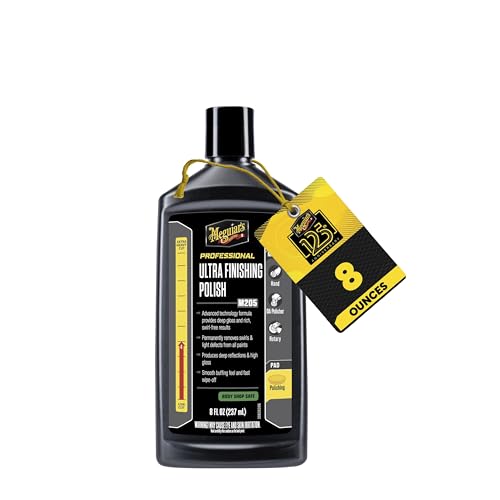
1. Meguiar’s Ultimate Polish
Meguiar’s Ultimate Polish is the right first bottle for most people. It is a gentle finishing polish that removes fine swirls and towel marks, the faint circular scratches that washing and drying leave behind, and brings back the deep, wet gloss that makes paint look new. It works by hand with a foam applicator or with a dual-action (DA) polisher, so you do not need any equipment to start.
Meguiar’s describes it as a pre-waxing glaze, and that is worth understanding. Alongside its light abrasives it contains conditioning oils that, in Meguiar’s words, add depth of colour and maximum gloss, especially on dark cars. Some of the improvement you see is those oils filling and enriching the surface rather than permanently levelling it, so it looks its best when you seal it in with a wax or sealant straight afterwards.
It is safe on clear coats and all glossy paints, and it is gentle enough that it is very hard to do damage with it. That is the main reason it is the best place to start: always try the least aggressive product first.
Best for: Light swirls, towel marks and dull paint, especially on dark colours, by hand or machine.
Pros:
- Gentle enough for beginners
- Works by hand or with a DA polisher
- Excellent gloss on dark paint
- Clear-coat safe
Cons:
- Only removes light defects
- Part of the gloss comes from oils, so wax over it
2. Meguiar’s Ultimate Compound
When a polish is not strong enough, you need a compound: a more abrasive product that cuts deeper defects out of the clear coat. Meguiar’s Ultimate Compound is the most popular step up, and it removes heavier swirls, light scratches, oxidation and water spots that a finishing polish will only soften.
Meguiar’s says its micro-abrasive formula cuts quickly without leaving the hazing that older rubbing compounds were known for, and that it is safe on clear coats and all gloss paints, by hand or with a DA polisher. In practice, follow it with a finishing polish such as Ultimate Polish if you want the deepest gloss, especially on dark paint.
Use it only where you need it. Compounds remove more clear coat with every pass, so work a test spot first and stop as soon as the defect is gone.
Best for: Heavier swirls, light scratches, oxidation and water spots that a polish cannot shift.
Pros:
- Removes defects a finishing polish cannot
- Hand or DA polisher
- Meguiar’s says it leaves no haze
- Restores faded, oxidised paint
Cons:
- Removes more clear coat than a polish
- Best followed by a finishing polish on dark paint
3. 3D One Hybrid Compound & Polish

3D One is designed to do the job of a compound and a finishing polish in a single step. Its abrasives start out cutting and break down as you work them, so the same product that removes swirls and oxidation also refines the finish to a high gloss. For a daily driver that just needs to look sharp again, that saves a whole stage of work.
3D describes it as a true correction product rather than a glaze, and says its formula produces no dust, which keeps cleanup simple. It works by hand for spot repairs and with a DA polisher for full panels, and it is made in the USA.
A single step is a compromise by nature. On very soft or very dark paint, a dedicated two-step correction will finish slightly better, but for most cars, most of the time, 3D One gets close enough to make the extra step unnecessary.
Best for: Owners who want one bottle that corrects and finishes in a single pass.
Pros:
- Compound and polish in one step
- Zero-dust formula
- Hand or DA polisher
- Made in the USA
Cons:
- A two-step correction finishes slightly better on soft or dark paint
- Larger bottle costs more than single-stage products
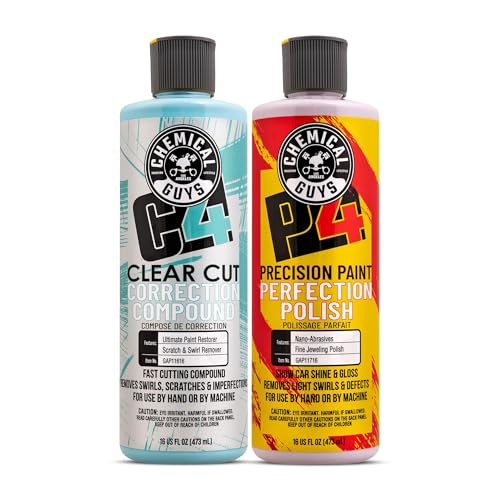
4. Chemical Guys C4 & P4 Paint Correction Kit
If you want to do a proper two-step paint correction, this kit gives you a matched pair. C4 Clear Cut Compound removes the defects (swirls, scratches, oxidation, towel marks and etching) and P4 Precision Polish then refines the surface, removing the micro-marring the compound leaves and bringing up depth and gloss.
Buying the two as a pair means they are designed to work together, which takes some of the guesswork out of choosing a compound and polish that suit each other. Chemical Guys says both are safe on clear coat, single-stage paint and ceramic-coated vehicles, and that they work by hand or with a dual-action or rotary polisher.
Two steps take roughly twice as long as one, so this is the kit for owners who want the best finish they can get and enjoy the process, not for a quick tidy-up before a sale.
Best for: Enthusiasts doing a full two-step correction for the best possible finish.
Pros:
- Matched compound and polish
- Safe on clear coat, single-stage and ceramic-coated paint
- Hand, DA or rotary
- Two full 16 oz bottles
Cons:
- Two steps take twice as long
- More than most cars need for routine upkeep
5. SONAX Perfect Finish

SONAX Perfect Finish is a one-step polish for people who already own a polishing machine and want true correction without fillers. SONAX says it removes scratches, water spots and sanding marks of P2000 grit or finer in a single step, without wet sanding or compounding first, and finishes hologram-free.
It is silicone-free, which is the important detail. With no oils or fillers to hide defects, what you see after wiping it off is the real state of the paint, so you can tell whether a defect is truly gone or just hidden until the next wash. Silicone-free products are also the type body shops prefer, because silicone residue causes problems when a panel is later repainted.
This is not a hand product. SONAX recommends a rotary polisher with its orange polishing pad (sold separately), and a rotary machine takes some practice to use safely, so it suits experienced users best.
Best for: Experienced machine users who want filler-free, one-step correction.
Pros:
- True correction with no fillers
- Silicone-free
- Removes P2000 sanding marks in one step, according to SONAX
- Hologram-free finish
Cons:
- Machine only; SONAX recommends a rotary polisher
- Small 250 ml bottle
6. 3D Speed All-In-One Polish & Wax

3D Speed combines a light polish with a protective wax, so one application removes light swirls, oxidation and minor scratches and leaves a layer of protection behind. For an owner who wants to improve their paint once or twice a year without turning it into a weekend project, it is the most practical bottle here.
3D says it goes on easily and wipes off clean without residue, by hand for quick jobs or with a DA polisher for whole panels, and that it is clear-coat safe. It is made in the USA.
The trade-off with any all-in-one is that it does neither job as well as a dedicated product. It will not correct as much as a compound, and the protection will not last as long as a standalone sealant or ceramic coating. For a quick, decent result, that is a fair exchange.
Best for: Owners who want to polish and protect in one quick step.
Pros:
- Polish and wax in one step
- Easy on, easy off
- Hand or DA polisher
- Clear-coat safe
Cons:
- Corrects less than a compound
- Protection does not last as long as a dedicated sealant
7. Turtle Wax T-417 Clean Cut Polishing Compound

Turtle Wax’s T-417 is a professional-grade polishing compound at a supermarket price, and an 18 oz tub goes a long way. Turtle Wax says it removes light swirl marks, minor scratches and oxidation, and restores gloss and colour on any automotive paint.
It is silicone-free, and Turtle Wax markets it as safe for use in professional detail, paint and body shops. It works by hand or with an orbital or rotary polisher, so it suits a beginner with a cloth as well as someone with a machine.
It is a compound, so it cuts more than a finishing polish. For the best gloss, follow it with a finer polish, or at least a coat of wax, rather than leaving it as the final step.
Best for: Tight budgets and older, oxidised paint.
Pros:
- Lowest cost on the list
- Silicone-free and body-shop safe
- Hand, orbital or rotary
- Large 18 oz tub
Cons:
- Needs a finishing polish or wax for the best gloss
- Basic packaging and instructions
Things To Keep In Mind Before You Buy
Polish, Compound or All-in-One?
These products sit on a scale from most to least abrasive:
- Compound (Meguiar’s Ultimate Compound, Turtle Wax T-417, Chemical Guys C4): the most cut. Removes heavier swirls, light scratches and oxidation, but can leave the finish slightly hazy.
- Finishing polish (Meguiar’s Ultimate Polish, Chemical Guys P4): fine abrasives that remove light swirls and refine the finish to maximum gloss.
- One-step (3D One, SONAX Perfect Finish): abrasives that break down as you work, so one product cuts and then finishes.
- All-in-one (3D Speed): a light polish combined with wax or sealant. The least correction, but the quickest route to a protected shine.
Always start with the least aggressive product that could do the job, try it on a small test area, and only step up to a compound if the polish is not enough.
Polishing Removes Clear Coat
Every polish and compound works by removing a very thin layer of clear coat. The clear coat is thin to begin with and does not grow back, so it is a limited resource. Correcting a car properly once or twice in its life is fine. Compounding it every few months is not. Use the gentlest product that works, and pay extra attention on edges and body lines, where the paint is thinnest and easiest to burn through.
Hand or Machine?
Polishing by hand is fine for light swirls and small areas, and every product on this list except SONAX Perfect Finish can be used that way. For a whole car, or for anything heavier than light swirls, a dual-action (DA) polisher does far more in far less time and is very hard to damage paint with. A rotary polisher cuts fastest but generates heat quickly and can burn through clear coat, so it is best left to experienced users. If you are buying a machine, see our guide to car polishers.
Fillers Versus True Correction
Some polishes, especially glazes and all-in-ones, contain oils or fillers that hide fine swirls rather than removing them. That is not a scam, and the results look excellent, but the defects can reappear after a few washes. Silicone-free products like SONAX Perfect Finish and Turtle Wax T-417 show you the true state of the paint when you wipe them off, which makes it easier to judge whether a defect is really gone.
Wash and Decontaminate First
Polish onto dirty paint and you grind that dirt into the finish. Wash the car thoroughly, dry it, and run a clay bar over the paint to lift the bonded contamination washing leaves behind. If the paint feels rough after washing, it needs clay before polish.
Protect the Result
Freshly polished paint has nothing on it, so protect it straight away. A coat of car wax gives the warmest look, and a paint sealant lasts longer. Either one will also keep the gloss from oil-based polishes from washing away.
Work in the Shade
Polish on a cool panel out of direct sunlight. On hot paint the product dries out before the abrasives have done their work, and becomes hard to buff off. Work one small section at a time, roughly two feet square, and wipe off with a clean microfibre towel.
Winners And Losers
Meguiar’s Ultimate Polish wins for most owners: it is gentle, easy to use by hand or machine, and gives superb gloss on dark paint. Meguiar’s Ultimate Compound is the right step up for heavier defects, and 3D One is the best way to correct and finish in a single step.
The Chemical Guys C4 & P4 kit is the choice for a proper two-step correction, SONAX Perfect Finish suits experienced machine users, 3D Speed is the quickest route to a polished and protected finish, and Turtle Wax T-417 is the budget pick.
The losers are expectations, not products: no polish fixes a scratch that has gone through the clear coat, and the most aggressive compound is rarely the best place to start.
To Sum Up
Wash and clay the paint, start with a gentle polish on a test area, step up to a compound only if you need to, and protect the finish when you are done. For most owners working by hand, that means Meguiar’s Ultimate Polish, with Ultimate Compound in reserve for anything it cannot shift.
For deeper damage, see our guides to car paint scratch repair kits and the different types of car scratches. For chrome and bright trim, which needs a different product, see our picks for the best car chrome polishes.
Frequently Asked Questions
What is the difference between car polish and wax?
Polish removes defects: it uses fine abrasives to level the clear coat and take out swirls, haze and light scratches. Wax protects: it adds a layer on top of the paint that shields it and adds shine, but it does not remove anything. Polish first, then wax or seal to protect the result.
What is the difference between polish and compound?
Compound is more abrasive than polish. It removes heavier swirls, light scratches and oxidation, but can leave a slight haze. Polish is finer: it removes light swirls and refines the finish to maximum gloss. For badly swirled paint, use a compound first and follow it with a polish.
Can you polish a car by hand?
Yes. Light swirls, towel marks and small areas can be polished by hand with a foam applicator and a gentle product such as Meguiar’s Ultimate Polish. For a whole car, or for heavier defects, a dual-action polisher does far more work in far less time and is still very safe on paint.
Will car polish remove scratches?
Polish removes swirls and light scratches that sit in the clear coat. If a scratch catches your fingernail, it has probably gone through the clear coat, and polish will only soften its edges. Deeper scratches need touch-up paint or a professional repair.
How often should you polish your car?
Only when the paint needs it, typically once or twice a year at most for a daily driver, and less often with a compound. Every polish removes a little clear coat, which does not grow back. Regular careful washing and a good wax or sealant mean you will need to polish far less often.
Do I need to wax after polishing?
Yes. Polishing leaves the paint clean but unprotected, and some polishes contain oils whose gloss washes away within a few weeks. A coat of wax, sealant or ceramic coating protects the freshly polished paint and locks in the shine. An all-in-one such as 3D Speed polishes and protects in one step.
