




If you’ve ever owned a diesel truck, you know that keeping your engine running smoothly isn’t just about regular oil changes.
Diesel fuel additives have become essential for maintaining peak performance, especially with today’s ultra-low sulfur diesel fuels that lack the natural lubrication properties older fuels had.
Many injector problems and much of the fuel economy loss on high-mileage diesels can be prevented with the right additive.
Choosing the right diesel fuel additive can make a real difference in your truck’s performance, fuel economy, and longevity.
The wrong choice might leave you with the same problems you started with, while the right one can boost your cetane rating, clean your injectors, and even help your truck start better in cold weather.
Below are seven well-established options, what each one is designed to do, and which kind of driver it suits, so you can avoid paying for features you don’t need.
Hot Shot’s Secret Everyday Diesel Treatment is built for routine, every-tank maintenance rather than one-off fixes.
This 16-ounce squeeze bottle treats up to 320 gallons of fuel, which works out to treating 20 gallons per ounce – a pretty solid ratio that keeps costs reasonable for daily drivers.
Its main appeal is that it tackles several issues at once. Hot Shot’s Secret claims a cetane boost of up to 7 points, and higher cetane mainly shows up as quicker, smoother cold starts.
Any fuel economy gain depends heavily on the engine and how dirty its injectors were to begin with, so treat mileage claims from any additive maker with caution.
The moisture dispersal feature has been particularly valuable during humid summer months when condensation can become a real problem. Instead of letting water sit in the bottom of the tank and cause corrosion, the formula is designed to disperse it so it burns off with the fuel.
That also helps fuel in a truck that sits for a couple of weeks between long hauls.
The lubricity improvement is where this product really shines for everyday use. Modern ultra-low sulfur diesel has less natural lubricity than older fuel, which is why lubricity is part of the formula.
Consistent use matters more than dose size: an additive used every tank does far more than a bottle poured in once a year.
The squeeze bottle makes dosing straightforward, though there are no measurement marks on the side. Follow the dosing chart on the bottle for your tank size.
For daily drivers who want consistent protection without breaking the bank, this hits the sweet spot between performance and affordability.
| Pros | Cons |
|---|---|
|
|
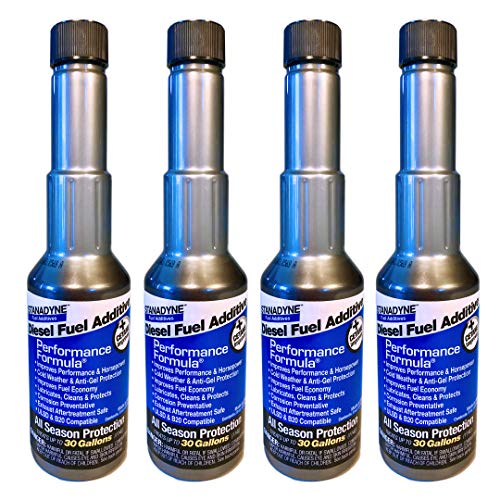
Stanadyne makes fuel injection equipment, and its Performance Formula is aimed at keeping injection systems clean and lubricated.
This four-bottle pack gives you 32 ounces total, with each 8-ounce bottle treating up to 40 gallons of fuel – that’s a treatment ratio that works out to about 5 gallons per ounce, making it more concentrated than many competitors.
The horsepower restoration is real, not just marketing hype. Stanadyne says its detergent system cleans injection deposits, which is where any recovered power comes from on an engine that has lost performance.
On an engine with dirty injectors, cleaning them typically shows up as better throttle response and smoother power under load.
The fuel economy improvement is where this product really pays for itself. Stanadyne also markets fuel economy gains; real results vary with engine condition.
Over the course of a year, that fuel savings nearly covers the cost of the additive, making it essentially free performance enhancement. The cetane improvement helps with more complete combustion, which explains both the power gains and efficiency boost.
What sets Stanadyne apart is their focus on wear protection through lubricity enhancement. Ultra-low sulfur diesel can be brutal on high-pressure injection systems, but this formula restores the lubricating properties that keep pumps and injectors healthy.
It suits trucks that see heavy-duty use and high annual mileage.
Cleaner combustion can also mean lower smoke. Black smoke under acceleration is often a sign of poor injector spray, which is the problem a detergent additive targets.
The four-bottle pack is convenient for stocking up, though the bottles lack detailed measurement markings.
| Pros | Cons |
|---|---|
|
|
This Archoil kit is aimed at diesels with existing performance issues rather than routine preventive maintenance.
The combination of AR6500 treatment and AR6400-D cleaner gives you both immediate cleaning power and long-term protection, which is exactly what you need for neglected fuel systems.
It is a good match for a truck with rough idle and poor fuel economy after years of running untreated diesel.
The AR6400-D cleaner is specifically formulated to tackle heavy deposits in injectors, and within about 200 miles of driving, his truck was running noticeably smoother. The idle cleaned up completely, and his fuel economy improved from about 14 MPG to over 16 MPG on his daily commute.
The AR6500 treatment portion is designed for ongoing maintenance after the initial cleaning. It boosts cetane significantly, which helps with combustion efficiency and power output.
The formula is designed around modern diesel fuel issues: today’s ultra-low sulfur diesel and the high-pressure common rail injection systems that are sensitive to fuel quality.
The DPF and turbo protection features are crucial for modern diesels. Poor combustion also loads the diesel particulate filter faster, and DPF repairs are expensive.
This kit helps keep those systems clean by promoting more complete combustion, which reduces the soot loading that clogs particulate filters and turbos.
One important note – this isn’t the right product for HEUI injector stiction problems, which Archoil clearly states. For those issues, you need their AR9100 Friction Modifier instead.
The 40-ounce bottle of AR6500 treats a substantial amount of fuel, making it cost-effective for high-mileage drivers, while the AR6400-D provides the deep cleaning that most other additives can’t match.
| Pros | Cons |
|---|---|
|
|
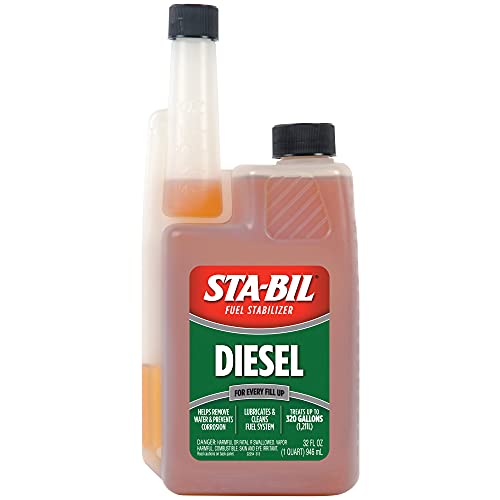
STA-BIL is best known for fuel stabilization, and its diesel formula is the one to pick for equipment that sits for extended periods.
This 32-ounce bottle treats up to 320 gallons, which works out to 10 gallons per ounce – not the most concentrated formula, but the stabilization properties are exceptional.
The 12-month fuel stability guarantee is what sets this apart from most other additives. That makes it a natural fit for backup generators and farm equipment that might sit for months between uses.
It works by slowing oxidation, which is what turns stored diesel dark and sludgy.
It also removes water, which matters most in storage tanks. Living in a humid climate, moisture contamination is a constant concern, especially in equipment that’s stored outside.
This additive actively removes water from the fuel system rather than just emulsifying it, which prevents the corrosion and microbial growth that can destroy fuel systems over time.
The comprehensive fuel system cleaning and lubrication is noticeable in daily use. It is a storage product first, so expect fuel protection rather than performance gains.
The lubricity improvement is crucial for protecting injection pumps and injectors from the harsh characteristics of ultra-low sulfur diesel.
The universal compatibility with ULSD and biodiesel blends makes this a versatile choice if you run different fuel types or aren’t sure what blend you’re getting at various fuel stops.
STA-BIL says it is compatible with biodiesel blends as well as standard diesel, which matters because biodiesel is less stable in storage.
| Pros | Cons |
|---|---|
|
|

Lucas Oil’s gallon-sized fuel treatment is the bulk option, useful for treating multiple vehicles or large fuel tanks.
This formula works with both gasoline and diesel, which is convenient if you have mixed fleets, and the gallon size offers excellent value for high-volume users.
Lucas markets it as a tune-up in a bottle: a lubricity and cleaning treatment for regular use.
The cleaning action on fuel injectors is noticeable – trucks that were running rough or had poor throttle response typically smooth out within a tank or two of treated fuel. The combustion chamber cleaning helps reduce carbon buildup that can cause knocking and reduce power output.
Expect modest results rather than dramatic ones; it is a general-purpose treatment, not a specialized diesel-only formula.
Lucas says the treatment helps reduce exhaust emissions, which can help keep the exhaust aftertreatment cleaner.
The sulfur neutralization is particularly valuable if you’re buying fuel from questionable sources or dealing with older stored fuel.
Lucas also says it neutralizes the effects of sulfur, which can cause corrosion in the fuel system.
The gallon size is both a blessing and a curse – it’s economical for frequent use, but the large container can be awkward to handle and measure from. A gallon jug is awkward to pour, so decanting some into a smaller bottle makes dosing easier.
The formula is also safe for older engines that were designed for leaded fuel, making it versatile for vintage equipment.
| Pros | Cons |
|---|---|
|
|

Opti-Lube XPD is built for cold weather, and the accessory package that comes with it makes it convenient to use. The gallon jug comes with a hand pump and two empty 8-ounce bottles, which solves the biggest problem with bulk additives – easy, accurate dispensing.
Its anti-gel properties are rated to keep fuel flowing down to -10°F. Gelled fuel strands a diesel completely, so anti-gel protection matters in any area with harsh winters.
For anywhere that sees sustained sub-zero temperatures, also see our guide to the best diesel anti-gel additives.
Opti-Lube also markets fuel economy gains; as with every additive here, results depend on the engine.
The injector cleaning capability is also excellent, with noticeable improvements in engine smoothness and throttle response after just a few tanks of treated fuel.
What sets this apart is the water separation technology that acts as a demulsifier. Instead of mixing water with fuel, it separates it so you can drain it out, which is much better for long-term fuel system health.
It also targets water, which helps prevent the corrosion and microbial growth that water contamination causes in equipment stored outside.
The storage life extension is impressive – fuel treated with this additive stays fresh for more than double the normal storage time. That makes it useful for stored equipment as well as daily drivers.
The hand pump makes it easy to measure exact amounts, and the travel bottles are perfect for keeping additive in the truck for when you fuel up away from home.
| Pros | Cons |
|---|---|
|
|
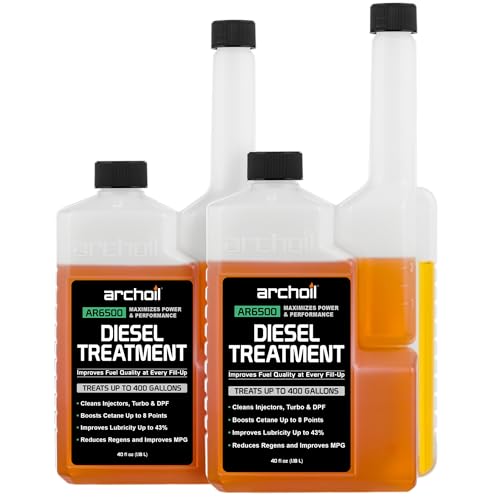
This two-pack of Archoil AR6500 gives you serious value if you’re running high mileage or have multiple diesel vehicles to treat. With 80 ounces total treating up to 800 gallons, it works out inexpensive per gallon.
It is formulated for modern high-pressure common rail systems and the deposit problems they face.
The maker says its combustion modifier improves both power and fuel efficiency.
The cetane boost is substantial and makes a real difference in cold weather starting and overall engine performance. Cleaner injectors and better combustion can also reduce diesel knock in older or high-mileage engines.
The formula also helps with more complete combustion, which reduces emissions and keeps the exhaust system cleaner.
It is designed to clean and protect the entire fuel system at once. It’s not just an additive that masks problems – it actually removes deposits from injectors while providing ongoing protection against future buildup.
That makes it a reasonable first step for a truck starting to show early signs of injector problems.
The two-pack format is perfect for stocking up or if you have multiple vehicles. How long a bottle lasts depends on tank size and mileage; the two-pack suits regular use.
The only downside is the upfront cost, but when you calculate the cost per gallon treated, it’s actually quite reasonable for the performance you get.
| Pros | Cons |
|---|---|
|
|
Things To Keep In Mind Before You Buy
• Treatment ratio matters more than bottle size – Some additives treat 40 gallons per ounce while others only treat 10 gallons, so calculate the actual cost per gallon treated rather than just looking at the bottle price.
• Cetane boost varies dramatically between products – Look for additives that increase cetane by at least 3-5 points if you want noticeable improvements in starting, power, and engine noise reduction.
• All-season vs winter-specific formulas – Some additives include anti-gel properties for cold weather while others are designed for year-round use, so consider your climate and storage conditions.
• ULSD compatibility is non-negotiable – Modern ultra-low sulfur diesel requires additives specifically formulated to restore lubricity, as older formulas may not address the lubrication issues that cause injector wear.
• Budget options work fine for basic maintenance, but invest in premium formulas if you’re dealing with existing problems – Simple fuel stabilizers cost less but won’t clean dirty injectors or fix performance issues like specialized treatment formulas will.
Winners And Losers
Clear winners emerge in different categories, depending on what you need from a diesel fuel treatment.
For the best overall daily driver, Hot Shot’s Secret Everyday Diesel Treatment hits the sweet spot. It provides solid cetane boost, good fuel economy improvements, and excellent value for regular maintenance without breaking the bank.
The 7-point cetane increase is noticeable, and the treatment ratio makes it cost-effective for daily use.
If you’re dealing with performance issues or have a neglected fuel system, the Archoil Diesel Fuel System Kit is the clear winner. The combination of deep cleaning and ongoing protection addresses both immediate problems and long-term maintenance in one package.
It’s more expensive upfront, but it actually fixes issues rather than just masking them.
For cold weather performance, Opti-Lube XPD takes the crown with its superior anti-gel properties and the convenience accessories that make it easy to use. The -10°F protection and significant fuel economy gains make it worth the premium price if you deal with harsh winters.
The best bulk value goes to the Archoil AR6500 two-pack, which gives you premium performance at a reasonable cost per gallon treated. It’s perfect for high-mileage drivers or multiple vehicle owners who want consistent results without paying single-bottle prices.
STA-BIL wins for equipment storage and fuel stabilization, offering unmatched 12-month fuel stability and water elimination that prevents long-term storage problems. Lucas Oil provides the best universal solution if you need one additive for mixed gasoline and diesel fleets.
Stanadyne Performance Formula offers the best measurable performance gains, with consistent horsepower increases and fuel economy improvements that justify its higher cost for performance-focused users.
To Sum Up
The right diesel fuel additive depends entirely on your specific needs and driving situation.
For daily drivers who want consistent protection and modest performance gains, Hot Shot’s Secret Everyday Diesel Treatment provides excellent value with noticeable improvements in cold starting and fuel economy.
If you’re dealing with existing performance problems or have a high-mileage truck that’s been neglected, invest in the Archoil Diesel Fuel System Kit. The combination cleaning and treatment approach will actually fix issues rather than just maintain what you have.
For cold weather driving, Opti-Lube XPD is worth the premium price for its superior anti-gel properties and convenience features.
High-mileage drivers should consider the Archoil AR6500 two-pack for its excellent value and proven performance in modern diesel systems. If you have mixed fleets or equipment that sits for extended periods, Lucas Oil and STA-BIL respectively offer the specialized solutions you need.
The key is matching the additive to your actual usage patterns rather than just buying the cheapest option or the most expensive one.
Buying Guide
When you’re shopping for diesel fuel additives, the most important thing to understand is that not all additives are created equal, and what works great for one situation might be completely wrong for another.
Think about your specific needs before getting caught up in marketing claims.
If you’re just doing regular maintenance on a daily driver, you don’t need the same heavy-duty cleaning formula that someone with a neglected high-mileage truck requires.
The treatment ratio is crucial to understand – some additives treat 40 gallons per ounce while others only treat 5 gallons, so you need to calculate the actual cost per gallon treated rather than just looking at the bottle price.
The cetane boost is probably the most important specification to pay attention to because it directly affects how your engine starts, runs, and performs.
Look for additives that increase cetane by at least 3-5 points if you want to notice real improvements in cold starting, reduced engine noise, and better throttle response.
Modern ultra-low sulfur diesel typically has a cetane rating around 40-45, but your engine will run much better with ratings in the 50+ range that good additives can provide.
Also consider whether you need all-season protection or winter-specific anti-gel properties – there’s no point paying extra for anti-gel additives if you live in a warm climate, but they’re absolutely essential if you deal with freezing temperatures.
The most common mistake is either buying the cheapest additive available or assuming the most expensive one is automatically the best.
Budget additives work fine for basic fuel stabilization and modest lubricity improvement, but they won’t clean dirty injectors or fix existing performance problems.
If your truck is running well and you just want to keep it that way, a basic additive like Hot Shot’s Secret or STA-BIL will serve you perfectly.
However, if you’re dealing with rough idle, poor fuel economy, or hard starting, you need to invest in a specialized cleaning formula like the Archoil system that can actually address these issues.
Think of it like choosing between regular maintenance and repair work – they require different approaches and different products.
Should You Also Clean Your Injectors While You’re At It?
Fuel additives protect against future deposits, but if your injectors are already dirty, pairing them with a dedicated diesel injector cleaner gives you a more thorough fix for rough idle and lost power.
Do You Need a Separate Anti-Gel for Winter?
Most everyday diesel treatments are not formulated to stop fuel gelling in real cold. If you drive where overnight temperatures fall below freezing, add a dedicated anti-gel from the start of the cold season, and keep an emergency de-gel product in the truck. Our guide to the best diesel anti-gel additives compares the options, including the fix for fuel that has already gelled.
How often should I use diesel fuel additive, and can I use it with every fill-up?
Most diesel fuel additives are designed for regular use with every fill-up, and that’s actually the best approach for maintaining optimal fuel system health. Using an additive with every tank makes sense for a daily driver, because modern ultra-low sulfur diesel lacks the natural lubrication properties that older fuels had. The key is following the manufacturer’s recommended dosage – more isn’t better and can actually waste money or potentially cause issues. For storage applications or equipment that sits for long periods, you might only need additive when you’re filling up for extended storage.
What’s the difference between cetane boosters and fuel system cleaners, and do I need both?
Cetane boosters primarily improve combustion quality, which helps with cold starting, reduces engine noise, and can improve power output, while fuel system cleaners focus on removing deposits from injectors and other fuel system components. Many modern additives combine both functions, which is usually the most practical approach. If your engine is running well, a combination product like Hot Shot’s Secret or Archoil AR6500 handles both needs effectively. However, if you have specific performance issues like rough idle or poor throttle response, you might need a dedicated cleaning product first, followed by a maintenance additive.
Are expensive diesel fuel additives really worth the extra cost compared to budget options?
The value depends entirely on your situation and what you’re trying to achieve. Budget additives like STA-BIL work great for basic fuel stabilization and modest lubricity improvement, and they’re perfect for equipment that sits for long periods or daily drivers that just need basic protection. However, premium additives like Archoil or Stanadyne offer significantly higher cetane boosts, better cleaning capabilities, and more comprehensive fuel system protection. If you’re dealing with performance issues, have a high-mileage truck, or want maximum fuel economy improvement, the premium products typically pay for themselves through better performance and fuel savings.
Can I mix different diesel fuel additives, or should I stick to one brand?
It is generally better to stick to one additive system rather than mixing brands, because you don’t know how different chemical formulations might interact. Most quality additives are designed to be complete solutions that address multiple issues simultaneously. However, there are some exceptions – you might use a specialized cleaner like Archoil AR6400-D for a specific cleaning treatment, then switch to a different maintenance additive for regular use. The key is understanding what each product does and avoiding redundant or potentially conflicting treatments.
How do I know if a diesel fuel additive is actually working in my truck?
There are several ways to tell if your additive is working effectively. The most immediate signs are easier cold starting, smoother idle, and reduced engine noise, especially the diesel knock that’s common in older engines. You should also track your fuel economy over several tanks – most good additives will improve mileage by 1-3 MPG if your engine was having efficiency issues. For cleaning products, you might notice improved throttle response and better power delivery, especially under load. Long-term benefits include fewer fuel system problems, cleaner exhaust emissions, and better overall engine performance. If you’re not seeing any of these improvements after several tanks of treated fuel, you might need a different additive or have issues that require professional diagnosis.
