


As an Amazon Associate I earn from qualifying purchases.




Cold weather is hard on car batteries, and the first frosty morning of the year is when many of them finally give out. A portable jump starter turns that into a five-minute fix you can do alone, without flagging down another driver or waiting for roadside assistance. Modern lithium units are small enough for a glove box and still carry enough power to start a V8.
For most cars and small SUVs, the NOCO Boost GB40 is the best portable jump starter: compact, spark-proof, and rated for gas engines up to 6.0 liters. For trucks and big V8s, step up to the NOCO GB70 or the Clore JNC325. Here are the six worth buying, and how to choose the right size for your engine.
Here is how they compare at a glance:
| Product | Rated Engine Size | Battery Type | Best For |
|---|---|---|---|
| NOCO Boost GB40 | 6.0L gas, 3.0L diesel | Lithium | Best overall |
| NOCO Boost GB70 | 8.0L gas, 6.0L diesel | Lithium | Trucks and V8s |
| Clore JNC325 | 8.0L gas, 6.0L diesel | Lithium | Heavy-duty cables |
| Clore Jump-N-Carry JNC660 | See listing (1,700 peak amps) | Lead-acid | Shop and fleet use |
| Schumacher SJ1332 | 7.0L gas, 4.0L diesel | Lead-acid power station | Jump starter plus air compressor |
| AstroAI S8 Ultra | All gas, 12L diesel (claimed) | Lithium | Budget pick |
1. NOCO Boost GB40 1000A Lithium Jump Starter
The GB40 is the jump starter most people should buy. NOCO rates it for gas engines up to 6.0 liters and diesels up to 3.0 liters, which covers nearly every car, crossover and small SUV, and says it delivers up to 20 starts per charge. At 2.5 pounds it fits in a glove box.
Its most important feature is safety. NOCO’s spark-proof and reverse-polarity protection means the clamps are not live until they are correctly connected, so clipping them on the wrong terminals does not cause a spark or damage. That matters on a dark, cold morning when you are working by flashlight.
It also works as a USB power bank and has a 100-lumen LED light with SOS and strobe modes. The housing is IP65 rated against water and dust, it recharges over USB-C in about three hours, and NOCO backs it with a one-year warranty.
Best for: Cars, crossovers and small SUVs with gas engines up to 6.0 liters.
Pros:
- Spark-proof and reverse-polarity protected
- Compact enough for a glove box
- IP65 housing, power bank and flashlight
Cons:
- Undersized for large V8s and big diesels
- One-year warranty
2. NOCO Boost GB70 2000A Lithium Jump Starter

The GB70 is the GB40’s bigger brother, rated for gas engines up to 8.0 liters and diesels up to 6.0 liters. That covers full-size pickups, large SUVs and most light-duty diesel trucks, and NOCO says it gives up to 40 starts per charge.
It keeps the same spark-proof and reverse-polarity protection, IP65 housing and USB power bank, with a much brighter 400-lumen light. The trade-offs for the extra power are weight, at 5 pounds, and a longer six-hour recharge.
Big engines and diesels draw far more current to crank, especially in the cold, so a pack rated for your engine size is worth more than any headline peak-amp figure.
Best for: Full-size trucks, large SUVs and diesels up to 6.0 liters.
Pros:
- Rated for 8.0L gas and 6.0L diesel
- Same UltraSafe protection as the GB40
- Bright 400-lumen light
Cons:
- Twice the weight of the GB40
- Six-hour recharge
3. Clore Automotive JNC325 Jump-N-Carry 2000A

Clore’s Jump-N-Carry name is a fixture in professional shops, and the JNC325 is its lithium answer to the NOCO GB70, with the same 8.0-liter gas and 6.0-liter diesel rating. Where it differs is the cabling: heavy-duty 24-inch #6 AWG cables with full-size clamps, which Clore says maximize the power delivered to the vehicle.
It also has an override function for totally dead batteries. Most smart jump starters will not switch on if they cannot detect any voltage at the battery, which is a safety feature; Clore’s override lets you start a battery down to 0.0 volts, after you have confirmed the connections are correct.
It charges over USB-C and includes dual USB outlets, a 12-volt outlet, a flashlight and a carrying case.
Best for: Trucks, farm and fleet vehicles, and anyone who wants heavier cables.
Pros:
- Heavy #6 AWG cables with full-size clamps
- Override for batteries at 0.0 volts
- Rated for 8.0L gas and 6.0L diesel
Cons:
- Override bypasses safety checks, so connections must be right
- Bulkier than glove-box packs
4. Clore Automotive Jump-N-Carry JNC660
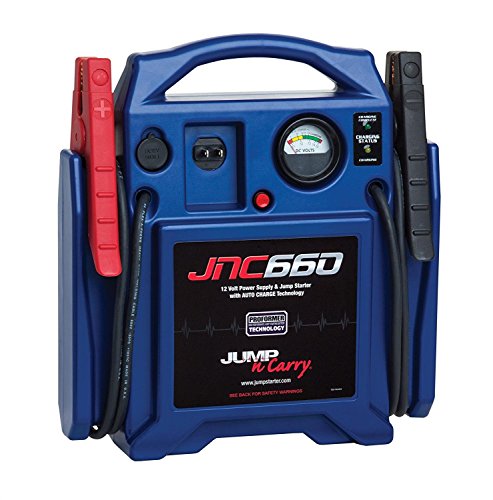
The JNC660 is the classic shop jump pack and a different kind of tool from the lithium units above. Instead of a lithium cell, it uses a 22Ah Clore Proformer battery designed for jump starting, rated at 1,700 peak amps, with long 46-inch #2 AWG cables, the heaviest here.
Long, heavy cables make it easier to reach batteries in awkward places, such as under a seat or in a trunk, and to jump vehicles parked nose-in. A built-in voltmeter shows the pack’s own charge, and there is a 12-volt outlet for accessories.
The downside is weight and bulk: a lead-acid pack is far heavier than lithium and lives in a trunk or garage rather than a glove box. Like any lead-acid battery, it should be kept charged between uses.
Best for: Home garages, shops and fleets that jump vehicles often.
Pros:
- Long 46-inch #2 AWG cables
- Battery designed specifically for jump starting
- Built-in voltmeter
Cons:
- Heavy and bulky
- No reverse-polarity protection listed, so connect carefully
5. Schumacher SJ1332 Jump Starter and Power Station

Schumacher’s SJ1332 is for drivers who want one box for every roadside problem. Besides jump starting, rated for gas engines up to 7.0 liters and diesels up to 4.0 liters, it has a built-in air compressor for topping up tires, a 200-watt inverter with 120-volt AC outlets, 12-volt DC and USB ports, and an LED light.
The compressor is the useful extra in winter, because tire pressure drops as temperatures fall and a low tire is as common a cold-morning problem as a weak battery. Schumacher lists protection against reverse polarity, short circuits and overheating.
It is a large power-station design rather than a compact pack, so it suits the trunk or garage, and like other lead-acid units it needs regular recharging.
Best for: Drivers who want a jump starter, tire inflator and AC power in one unit.
Pros:
- Built-in air compressor
- 200W inverter with AC outlets
- Reverse polarity, short circuit and overheat protection
Cons:
- Large and heavy
- Needs regular recharging in storage
6. AstroAI S8 Ultra Lithium Jump Starter

The AstroAI S8 Ultra is the budget pick, and a capable one. It has smart clamps with spark-proof and reverse-polarity protection, an IP65 housing, a 300-lumen light and a USB-C and USB-A power bank, all in a 1.79-pound pack, and AstroAI says it is tested to UL, FCC and IEC standards.
Treat its headline figures with care. AstroAI claims 4,000 peak amps and compatibility with all gas engines and diesels up to 12 liters, numbers far above packs that cost twice as much. Peak-amp ratings on jump starters are not measured to a common standard, so they say little about real cranking ability; the brands above that rate by engine size give a more honest guide.
AstroAI’s own listing also gives useful cold-weather limits: operate and store it between -4°F and 122°F, and charge it only between 32°F and 113°F.
Best for: Budget buyers with ordinary cars who want a compact backup.
Pros:
- Low price
- Spark-proof smart clamps and IP65 housing
- Very light at 1.79 pounds
Cons:
- 4,000A and 12L diesel claims are not credible at this size
- Do not charge it below freezing
Things To Keep In Mind Before You Buy
Buy for Your Engine Size, Not Peak Amps
Peak-amp figures are the biggest number on every box and the least useful one. There is no common test behind them, which is how a small pack can claim 4,000 amps. Look for the engine sizes a maker rates the pack for, and leave some margin for cold weather and for diesels, which take much more current to crank.
Lithium and Cold Weather
Lithium packs lose capacity in extreme cold and should not be charged below freezing. In a harsh winter, keep the pack in the house and bring it out when needed, or at least warm it in the cabin for a few minutes before use. Follow the temperature limits in the manual for whichever pack you buy.
Keep It Charged
A jump starter that has sat flat in the trunk since last winter will not help. Top it up every few months, and after every use. Lithium packs hold their charge well; lead-acid packs need more frequent charging.
A Jump Is Not a Fix
A battery that needs a jump has a reason: age, a fault in the charging system, or a parasitic drain. If it happens twice, test the battery and charging system rather than relying on the jump starter.
Winners And Losers
The NOCO Boost GB40 wins for most drivers: safe, compact and rated for engines up to 6.0 liters. For trucks and diesels, the NOCO GB70 and Clore JNC325 are the picks, with the Clore’s heavier cables and dead-battery override suiting heavy use.
The Clore JNC660 remains a great garage and shop tool, and the Schumacher SJ1332 is the choice if you want an air compressor and AC power in the same box.
The AstroAI S8 Ultra is the weakest on honest specifications, since its peak-amp and engine-size claims are inflated, but it is a capable compact backup for an ordinary car at a low price.
To Sum Up
Choose a jump starter rated for your engine, prefer spark-proof clamps, keep it charged, and keep a lithium pack warm in deep cold. Then if the car will not start on a winter morning, the fix takes minutes instead of a long wait.
Our step-by-step guide on how to jump start a car covers the connection order. If your battery keeps dying, the guide on how long a car battery lasts explains when it is time to replace it, and the car battery voltage chart shows how to test it. NOCO fans can compare the whole range in our NOCO jump starter roundup.
Frequently Asked Questions
What size jump starter do I need?
Match the jump starter to your engine. Most makers rate packs by engine size, such as NOCO’s GB40 for gas engines up to 6.0 liters and diesels up to 3.0 liters, and the GB70 for 8.0-liter gas and 6.0-liter diesel. Diesels and cold weather need more power, so leave some margin.
Are peak amps a good way to compare jump starters?
Not really. Peak-amp figures are not measured to a common standard, which is why some small packs claim several thousand amps. The engine sizes a maker rates the pack for are a more reliable guide.
Can I leave a jump starter in my car in winter?
You can, but lithium packs lose capacity in extreme cold and should not be charged below freezing. In a harsh winter, keep it indoors and bring it with you, or warm it in the cabin before use. Check the pack’s manual for its temperature limits.
How often should I charge a portable jump starter?
Recharge it after every use and top it up every few months in storage. A pack that has sat flat for a season may not have enough charge when you need it.
Can a jump starter start a completely dead battery?
Many smart jump starters will not switch on if they detect no voltage at the battery, as a safety measure. Some, like the Clore JNC325, have an override for batteries down to 0.0 volts; use it only after confirming the clamps are on the correct terminals.
Is it safe to use a jump starter myself?
Yes, if you follow the instructions. Spark-proof, reverse-polarity protected packs like NOCO’s will not send power if the clamps are connected the wrong way. Connect red to positive and black to a ground point or the negative terminal, then start the car.
